 Ben Green
Crews have launched tunnel boring operations on the $5.6-billion Blue Line metro expansion, beginning excavation on a 15.5-km underground corridor that will extend Dubai’s automated rail network into nine districts currently without metro service.
Sheikh Mohammed bin Rashid Al Maktoum, vice president and prime minister of the United Arab Emirates and ruler of Dubai, activated the first tunnel boring machine May 3, according to state news agency WAM. Construction began in June 2025, as ENR previously reported, and the project is now 20% complete and on track to reach 30% by year’s end. The line is set to open Sept. 9, 2029—the 20th anniversary of Dubai Metro’s original launch.
“Our projects in Dubai are … guided by clear plans, precise timelines and national talent capable of turning vision into tangible achievements in practice,” Sheikh Mohammed told state media.
The design-build contract was awarded in December 2024 to the MAPA–Limak–CRRC consortium. Turkish contractors MAPA and Limak are overseeing civil works, while China Railway Rolling Stock Corp. is supplying rail systems and 28 driverless trains. A joint venture of AtkinsRéalis and Parsons—whose prior Dubai work includes the Red and Green metro lines—is serving as engineer.
More than 10,000 workers have been mobilized, with more than 500 engineers and experts overseeing delivery and 180 rail specialists embedded in operations, according to state media and project officials. The consortium has logged more than 13 million work hours without a lost-time injury, according to project statements.
Underground Works, Challenging Creek-Side Soils
Initial drives are proceeding in three directions from a launch shaft at International City 1, an eastern Dubai district serving as the line’s primary underground interchange.
The launch shaft at International City 1 will anchor the metro system’s largest underground interchange station, a more than 44,000-sq-m structure designed to handle projected passenger volumes of 350,000 riders daily, according to WAM.
This double-shield tunnel boring machine is similar to “Al Wugeisha”and the other two TBMs being deployed on Dubai’s $5.6-billion Blue Line metro expansion. These machines are designed to maintain excavation progress through variable subsurface conditions while simultaneously installing segmental tunnel linings.
The Dubai Roads and Transport Authority (RTA) named the lead TBM “Al Wugeisha.” The machine is 163 m long, weighs more than 2,000 tonnes and operates around the clock, with advance rates ranging from 13 to 17 m per day, according to WAM. The names of the other TBMs were not identified.
RTA geotechnical investigations previously reviewed by ENR indicate the corridor traverses unconsolidated marine sands and sabkha deposits interspersed with gypsum lenses and subterranean voids.
The groundwater table sits just three to four meters below grade in hypersaline conditions, increasing corrosion and inflow risks, while loose deposits carry a liquefaction risk under load.
The subsurface conditions require earth-pressure-balance machines with foam conditioning, segmental linings fitted with hydrophilic gaskets, continuous dewatering systems and extensive borehole and cone-penetration testing, according to the RTA geotechnical report.
The project’s underground and elevated works are being supported by dedicated precast tunnel-ring and viaduct factories operating alongside two concrete batching plants to sustain concurrent multi-front construction. Project materials indicate the facilities are capable of producing up to 12 tunnel rings and 10 to 12 viaduct segments daily.
A New Third Corridor
Dubai Metro’s existing network, one of the world’s longest fully automated metro systems, runs 90 km across 53 stations on the Red and Green lines, both delivered with Parsons as a key consultant.
The Blue Line will become the system’s third major corridor, connecting to the existing network at Creek Station on the Green Line and Centrepoint Station on the Red Line. The project follows earlier expansion phases that included Dubai Tram and the Route 2020 extension built for Expo 2020 Dubai.
The project’s 14 stations include three interchange stations, seven elevated stations and four underground stations, with a maintenance depot at Al Ruwayyah 3 designed to hold 60 trains, according to consortium member Limak. Construction has begun on piers for a 1.3-km viaduct over Dubai Creek—the first elevated metro crossing of the waterway—with bridge structures expected to take shape by June 2027.
The Blue Line’s primary route will extend east from central Dubai through growing residential and technology districts, while a second branch will connect northeastern suburban areas into the metro network.
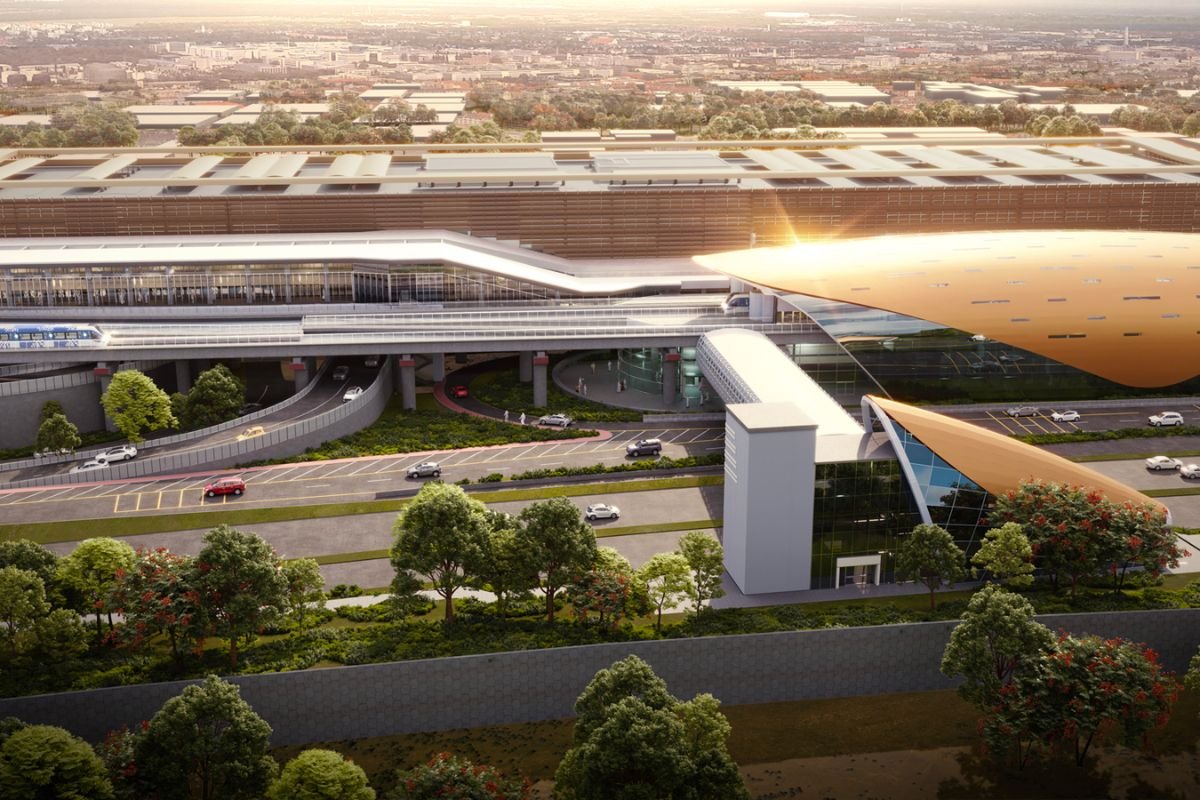
A rendering depicts Dubai Metro’s planned Dubai Creek Harbour station on the $5.6-billion Blue Line expansion. Designed by Skidmore, Owings & Merrill, the structure is projected to rise 74 m.
Among the project’s signature structures is the Dubai Creek Harbour station—officially Emaar Properties Station—designed by New York City-based Skidmore, Owings & Merrill. SOM said the station will rise 74 m, making it the world’s tallest metro station.
The line will use third-rail electrification, platform-screen doors and communications-based train control technology intended to support two-minute train headways, according to Parsons.
Read More: ITER Magnet Milestone Tests Fusion’s Construction Supply Chain
At a design capacity of 46,000 passengers per hour, the line is projected to carry 200,000 daily riders by 2030 and 320,000 by 2040. Total projected benefits exceed $15.4 billion by 2040, including a 20% reduction in corridor traffic congestion, according to WAM.
Dubai officials also said the Blue Line is the emirate’s first transportation project designed to fully comply with green building standards and target LEED Platinum certification.
The Blue Line joins several major UAE rail projects now advancing, including Dubai’s planned Gold Line and Etihad Rail Mobility’s separately awarded Abu Dhabi-Dubai high-speed rail corridor, reported in February.

 ENGR. AKIN

 Ben Green