Ben Green
- Seven dining rooms illuminated by voids that double as lightwells
In our latest lookbook, we’ve rounded up homes spanning Chile, Ireland and Japan with dining rooms that are brightened by glass-covered voids.
Lightwells and internal voids offer a solution to drawing light into a home’s lower levels or deeper into its plan, while also adding visual intrigue and depth to an interior.
Here, we look at seven homes where glazed voids create brighter and loftier dining spaces, including a skylit pyramidal dwelling in Mexico.
This is the latest in our lookbooks series, which provides visual inspiration from Dezeen’s archive. For more inspiration, see previous lookbooks featuring compact bedrooms, statement fireplaces and bathrooms with contrasting materials.

House in the Forest, Chile, by Daiber & Aceituno Arquitectos
Chilean studio Daiber & Aceituno Arquitectos cloaked this two-storey home in corrugated metal and raised it atop concrete arches on its site in the forest of Puerto Varas, Chile.
On the home’s ground floor, an open-plan kitchen and dining room gain light from a central void designed by the studio to act as a “luminous heart within the home”.

Casa Emma, Mexico, by HW Studio
A pyramidal lightwell draws daylight into the wood-clad interiors of Casa Emma, a Mexican home completed by local architecture practice.
Nestled into an infill lot in Morelia, the residence measures four metres by 10 metres and is organised around a central skylit room that contains the kitchen, living and dining spaces, and a bedroom above.

Gate Lodge, Ireland, by A2 Architects
Irish studio A2 Architects designed this home, named Gate Lodge, with a minimal white form topped by a pyramidal roof for a young farming family in Navan, Ireland.
Inside, a circular void aligns with a square skylight at the apex of the pyramidal roof – drawing light down into the dining room at the centre of the home.
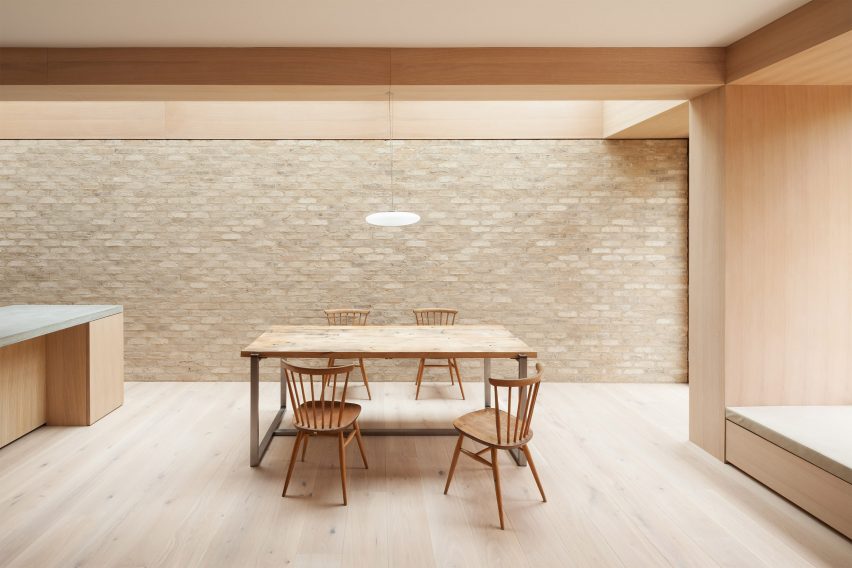
Harvey Road, UK, by Erbar Mattes
Limewashed brick, oak and glass make up this rear extension to a London home completed by architecture studio Erbar Mattes.
Held within the space is an open-plan kitchen and living space flanked by a window seat and a dining space crowned with a deep-set skylight.
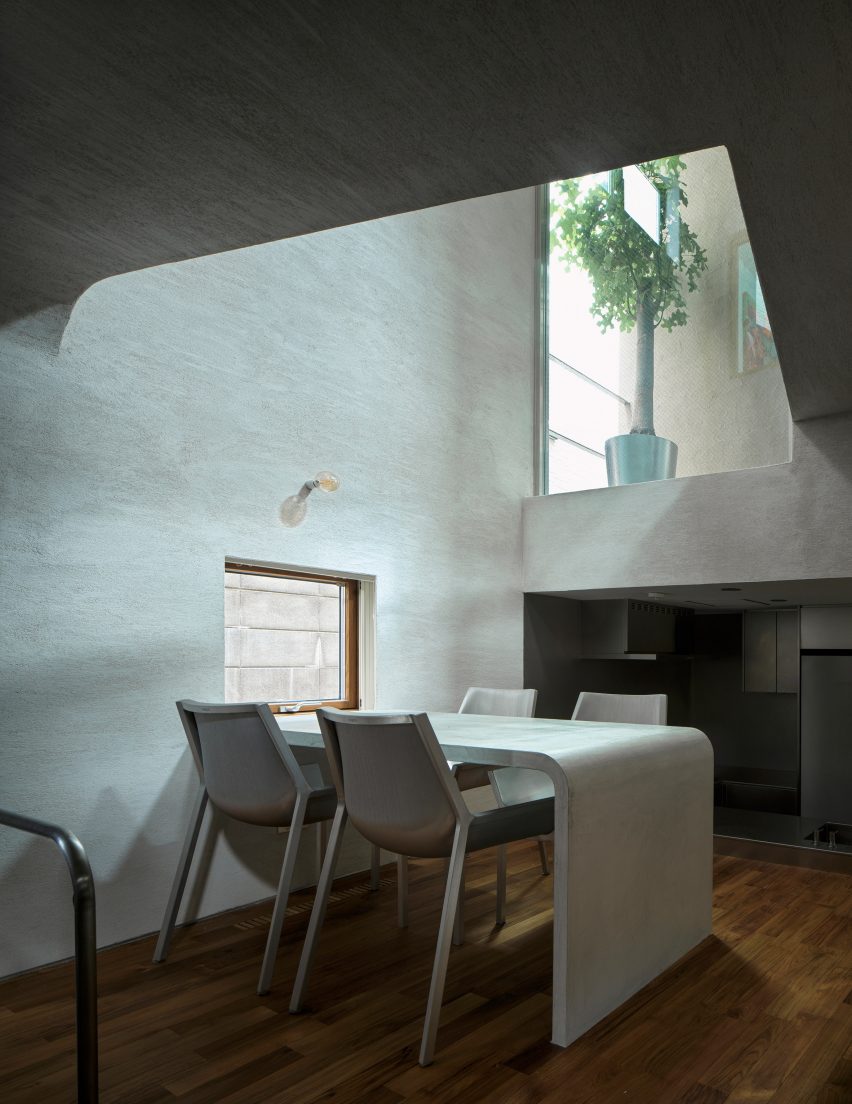
A Japanese Manga Artist’s House, Japan, by Tan Yamanouchi & AWGL
Architecture studio Tan Yamanouchi & AWGL drew on the creativity of its client – an up-and-coming manga artist – for the design of this house and studio with a curving facade in Tokyo, Japan.
Located on a narrow site, A Japanese Manga Artist’s House is accessed via an arched tunnel and opens up to a living space where a large void illuminates the home’s dining area.

Sky Lantern, UK, by Proctor & Shaw
The refurbishment and extension of this Victorian townhouse in south London by local studio Proctor & Shaw saw a series of glazed volumes added to its rear facade to allow daylight to reach deep into the plan.
On the ground floor of Sky Lantern House, the open-plan kitchen and dining area are illuminated by a double-height void wrapped in glazing.
Read more: Spazio Leone Gallery unveils showroom in former Victorian textile factory

 Ben Green